by Margarita Valle
In our society or elsewhere in this chauvinistic world, being female is daunting enough. The challenges that we face are gargantuan, to say the least, such that we must exert every effort to assert our rights even as a citizen whose fundamental birthrights are supposedly assured by the Philippine Constitution.
In some societies outside ours, even fetuses whose gender is not desired by the patriarch in the family do not stand a chance to even exist. More so, elsewhere globally, very young girl-children have become easy prey for sex traffickers whose influence among law enforcers is so deeply entrenched that no law can be applied to them.
The odds against us are definitely countless, simply because we are females. It makes it even more daunting when we follow our hearts’ desire to be consistent with our nature… to be truth-tellers.
Women journalists face more than double the challenges being faced by women in society. From having to deal with a work environment that has been dominated by male superiors since time, to dealing with sources who have the same mindsets as their male counterparts elsewhere where misogyny is the order of the day, women journalists have to don an invisible armor or be equipped with a psychological shield that could withstand attacks from all over.
Overall, I would just like to read a situationer by the National Union of Journalists in the Philippines as follows:
“Threats to Truth-telling, Free Expression Worsen During Marcos Jr.’s First Year in Office
One year into the presidency of Ferdinand Marcos Jr., the state of free expression has not improved. In fact, it has further deteriorated in the Philippines.
President Marcos Jr. pledged to uphold press freedom. The National Union of Journalists of the Philippines, however, recorded 84 incidents of attacks on the media from June 30, 2022 until July 22, 2023. This number is 42 percent higher compared to the documented cases during Duterte’s first 13 months in office.
Three journalists have been killed while four others survived two separate shooting incidents. The July 14 shooting of San Juanico TV reporters in Pastrana, Leyte by members of the local police and the subsequent surveillance and harassment they are subjected to prove that a lot has to be done to address impunity in the country.
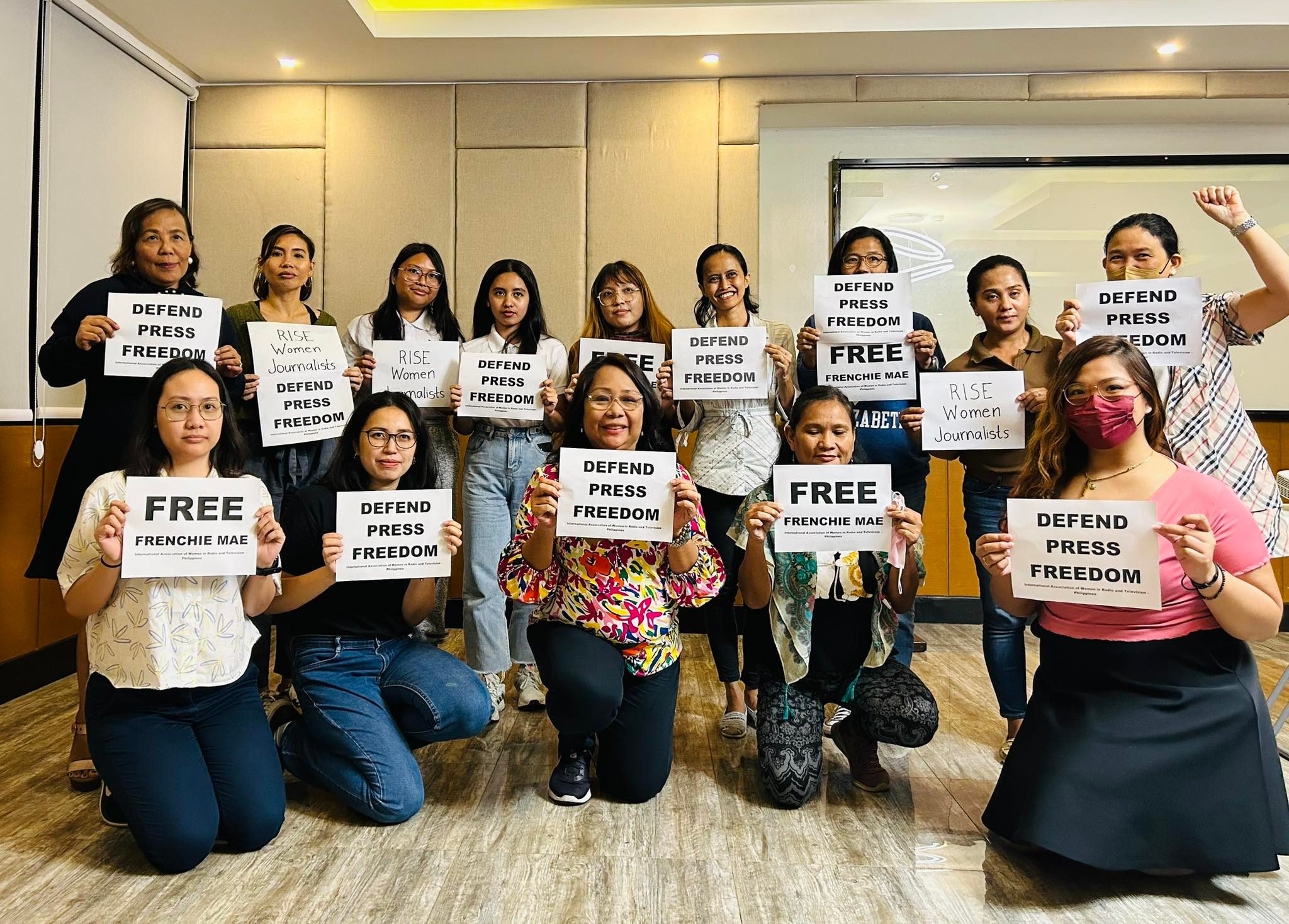
Community journalist Frenchie Mae Cumpio and dozens of artists, including Adora Faye de Vera, Amanda Echanis, JP and Grace Versoza, Lorie Sigua, and Aldeen Yañez among others, continue to languish in jail over trumped-up criminal charges. Their only crime is that they have utilized their skills and talent to amplify the voices of marginalized and oppressed sectors.
Libel laws continue to be wielded as a form of harassment against journalists. The Court of Appeals upheld the conviction of Maria Ressa and Reynaldo Santos Jr., and even extended the prescription period of cyber libel from 12 years to 15 years. Last December 2022, journalist Frank Cimatu was convicted of cyber libel over a satirical social media post pertaining to former Agriculture Secretary Manny Piñol.
The blocking order against the websites of media outfits Bulatlat and Pinoy Weekly, and of several progressive people’s organizations stands. For publishing critical news and views, they continue to be censored by the Philippine government.
President Marcos Jr. also remains silent on various attacks against freedom of expression, especially in support of the right to assemble and seek redress for grievances.
The red-tagging of journalists, artists, activists, and anyone expressing opinion contrary to government narratives persists. The government task force mandated to end the armed conflict and their minions attempt to portray as “terrorists” those who voice out legitimate criticisms and concerns. The entire state machinery, under the guise of the “whole-of-nation-approach” is used to curtail not only free expression but also the right to organization of different sectors pushing for their rights and welfare.
State forces wield the anti-terror law as a weapon against human rights defenders. The Anti-Terror Council has designated as terrorists indigenous peoples activists in the Cordillera, and a community doctor in Mindanao despite the dismissal of fabricated charges filed against these human rights defenders. In the Southern Tagalog region alone, 15 activists, including two Church leaders, have been charged with violation of the Anti-Terror Act.
Marcos Jr. has not lifted a finger to undo the excesses and abuses of Duterte. His inaction is taken as a go-signal by those who continue to violate the people’s right to free speech and free expression.
We, journalists, artists and advocates, speak now to challenge the Marcos Jr. administration to reverse the policies of his predecessor and uphold and respect the people’s rights.
Free Frenchie Mae Cumpio and all detained artists and human rights defenders!
Stop censorship! Unblock the truth!
Junk the Anti-Terror Law!
Artists and Media, Fight Back!”
I too have had my share of undesirable experiences and challenges some years back in my career, perhaps to a lesser degree. And because during our younger days, our consciousness about gendered abuses was so limited, we somehow just let it pass without so much of a whimper.
Thus it took years, and seemingly a strong “shaking” from a deep slumber when I actually experienced an attack against my person at a time when I was all alone, an unaccompanied “elderly” in a strange place in my revered island of Mindanao, that I realized the gravity of our situation as journalists. Though I was physically unharmed, the psychological and mental torture was almost unbearable, as the aftermath “what ifs” tormented me daily as I struggle to keep my sanity intact, up until the present time.
Questions like what if I lost my cool and fought back, would I have survived that ordeal? Had I been a young journalist, would I have had the chance not to be molested, killed, and later dumped in some deserted area and left to rot? Had I not been able to get in touch with a close family member on a call, would my whereabouts and my predicament be known?
These are just a few of my mental health issues that until now still haunt me and keep me from living a “normal” life, (or meron bang ganu’n?)
Rappler’s Maria Ressa’s case is a celebrated one, but there have been countless cases of abuse perpetrated against women journalists that have not been known and addressed, and still awaiting justice, just like that of Frenchie Mae and many others.
The brighter side, however, is that nowadays there are organizations that are carrying our causes and taking up the cudgels for us and our issues, something that we cannot expect each of our news outfits will do.
I will always be endlessly grateful to my fellow journalists back home who stood by me when I was down and out, to the National Union of Journalists in the Philippines (NUJP) and to the International Association of Women in Radio and Television (IAWRT) – Philippines that literally nurtured me in my most vulnerable moments, boosting my confidence and made meaning of my struggles through all those difficult times. I want you to know, especially my sisters in IAWRT Philippines’s Board of Directors who are always there for me, that I am grateful.
For now, I can truly say I am slowly but surely taking back my strength, though it might take more time to really feel safe and secure, as a friend once said, “There is really no timeline for mental health.” So, Sisters, we need to take care of ourselves and continue to be beautiful and strong for each other. I love you all…